


Muzica uses a distinct stylistic approach for each genre: when composing arabesque, it adopts a language of melancholy and longing; in folk songs (türkü), it preserves the traditional refrain structure; in Turkish classical music, it remains faithful to the aesthetics of maqam; and in lullabies, it favors short and repetitive syllabic patterns. Launched in Istanbul in the last quarter of 2025, Muzica was developed by DokuzDoksanDesign, the application and content team of DokuzDoksan Advertising Agency. Focused on generating Turkish-language songs with AI, Muzica is currently available on iOS, Android, and the web via muzica.tr.
Built by a team of four, the first version of Muzica was developed in approximately seven months. The iOS app was written from scratch using Swift/SwiftUI, the Android app was built with Flutter, and the web platform runs on Next.js. The team states that all 33 AI personas—each designed for a specific music genre—along with the custom prompt architecture and genre-based parameter optimization, were developed بالكامل in-house.
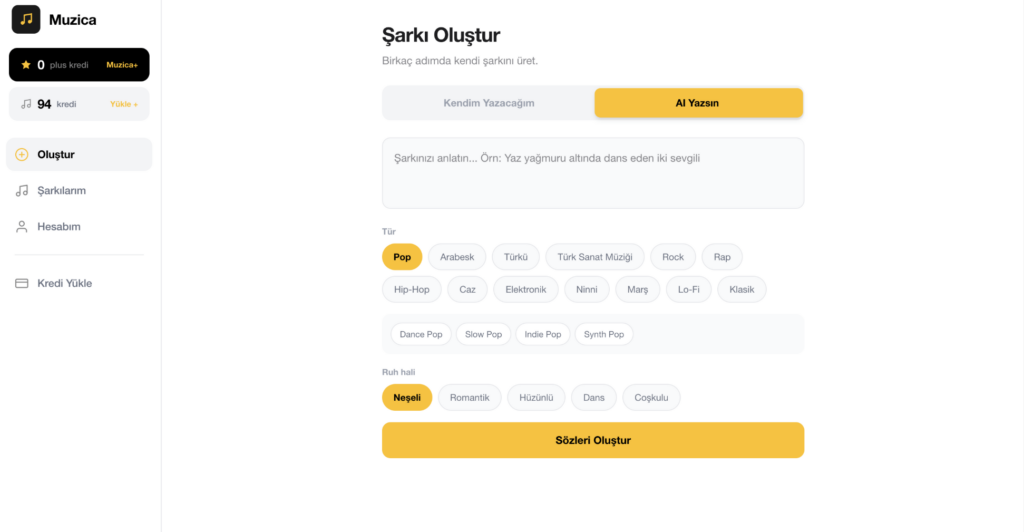
According to the startup, the platform has around 3,000 monthly active users and is simultaneously available across three platforms (iOS, Android, web). The average user session lasts 18 minutes. Installation takes about 30 seconds, while generating a song takes approximately 3 minutes. Muzica offers a total of 33 music genres, 40 instruments, 6 mood modes, and 33 AI personas, available in both Turkish and English.
Users can either write their own lyrics or get assistance from AI through prompts. After selecting the genre, mood, and vocal style, they can start generating their song. While international platforms such as Suno, Udio, Soundraw, and MusicHero exist, the team emphasizes that none offer a truly localized Turkish music experience, instead functioning as translated versions of English-based platforms.
The team highlights that Muzica is specifically designed to meet the needs of Turkish users. It enables users to create personalized songs for occasions such as Valentine’s Day, birthdays, lullabies for babies, or even fan chants. Of the available genres, 17 are rooted in Turkish music—such as arabesque, türkü, Turkish classical music, Anatolian rock, lullabies, and marches—while 11 instruments include traditional ones like bağlama, ney, kanun, darbuka, kemençe, and zurna. The AI understands the emotional depth of arabesque, the syllabic structure and refrains of folk songs, and the stylistic rules of each genre. Each genre is powered by a separate AI model operating under its own set of rules.
To date, the project has not received any external investment and is fully funded by the team’s own resources. Muzica operates on a freemium model: users start with one free trial credit, then can purchase credit packages or subscribe to Muzica+ on a monthly basis.
In the short term, the startup is focused on organic growth within the Turkish market. With English language support already in place, it is also preparing for international expansion. By the end of the year, the team aims to increase its monthly active users by 10x and achieve a sustainable revenue model.
Source: Webrazzi
