

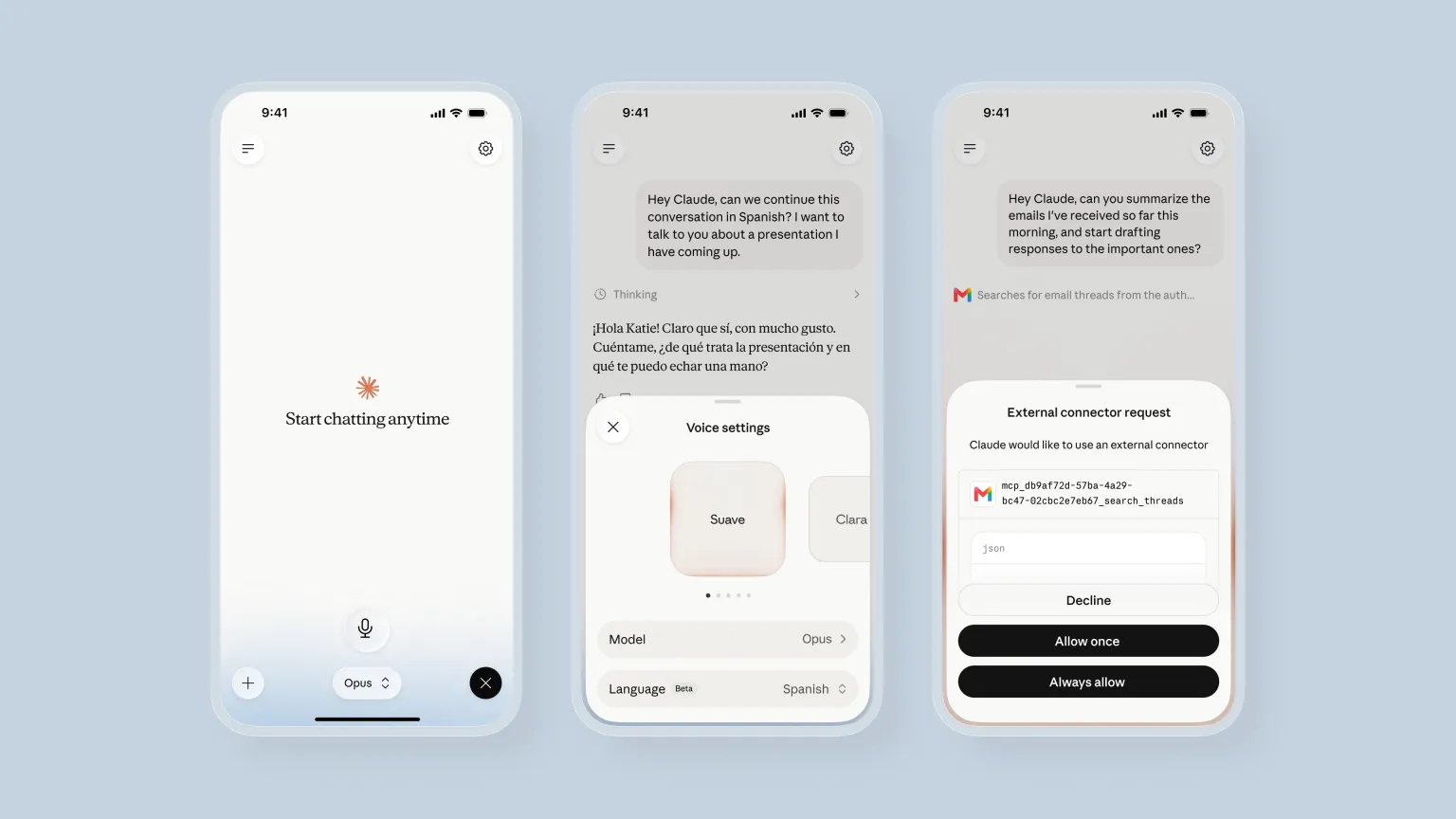
Anthropic has upgraded Claude’s Voice Mode, allowing users to access its more powerful Opus and Sonnet AI models during voice conversations instead of being limited to the lightweight Haiku model. The move brings Claude’s voice experience closer to its text-based capabilities as competition in AI assistants continues to intensify.
Previously, Claude Voice relied exclusively on the Haiku model, which prioritized speed over advanced reasoning. With the latest update, Voice Mode now automatically uses the last model a user selected in text chat, making it possible to tackle longer, more sophisticated conversations while maintaining a seamless transition between typing and speaking.
The enhanced voice experience is designed for more than casual conversations. Anthropic says users can brainstorm product ideas, rehearse client pitches, receive communication feedback, and work through complex problems entirely through voice interactions. Users can also switch between Haiku, Sonnet, and Opus during an ongoing conversation without losing context.
Another significant addition is deeper integration with productivity tools. Claude Voice can now access connected services such as Gmail, Google Calendar, Google Docs, and Slack, enabling users to complete real-world tasks—including checking schedules, summarizing email threads, and managing work—without leaving voice mode.
Anthropic has also expanded language support beyond English. Voice Mode now supports French, German, Spanish, Portuguese, Japanese, Korean, Hindi, Indonesian, and Italian, marking its transition from beta to a broader public rollout.
Why it matters
The update signals that the competition in AI voice assistants is shifting beyond natural conversation toward AI-powered productivity. While rivals such as OpenAI have focused heavily on making voice interactions feel more human, Anthropic is positioning Claude as a practical workplace assistant capable of executing tasks across connected applications.
For businesses and professionals, the ability to combine advanced reasoning models with voice interactions and enterprise integrations could make AI assistants increasingly useful for everyday workflows—reducing friction between conversation, planning, and execution. As AI companies race to become users’ primary digital assistant, voice is quickly evolving from a novelty into a core productivity interface.
